
Introduction
You have the idea, the co-founder and perhaps your first client. Then comes the question that stalls many founders for weeks: should this be an LLP or a Private Limited Company?It is a bigger decision than it looks. The structure you pick today decides how much tax you pay on every rupee of profit, how much paperwork lands on your desk each year, and whether an investor will take your pitch seriously.
The good news is that the answer usually comes down to a few honest questions about your plans. This guide walks you through them, using the law as it stands for financial year 2026-27.
Start here: a 60-second self-check
Answer these five questions with a simple yes or no.1. Do you plan to raise money from angel investors or venture funds in the next three years?
2. Will you want to offer stock options (ESOPs) to employees?
3. Will most of the profit stay in the business for growth, rather than be withdrawn by the owners?
4. Are your main customers large corporates, MNCs or government bodies?
5. Do you expect foreign investment in a sector that has conditions or caps on FDI?
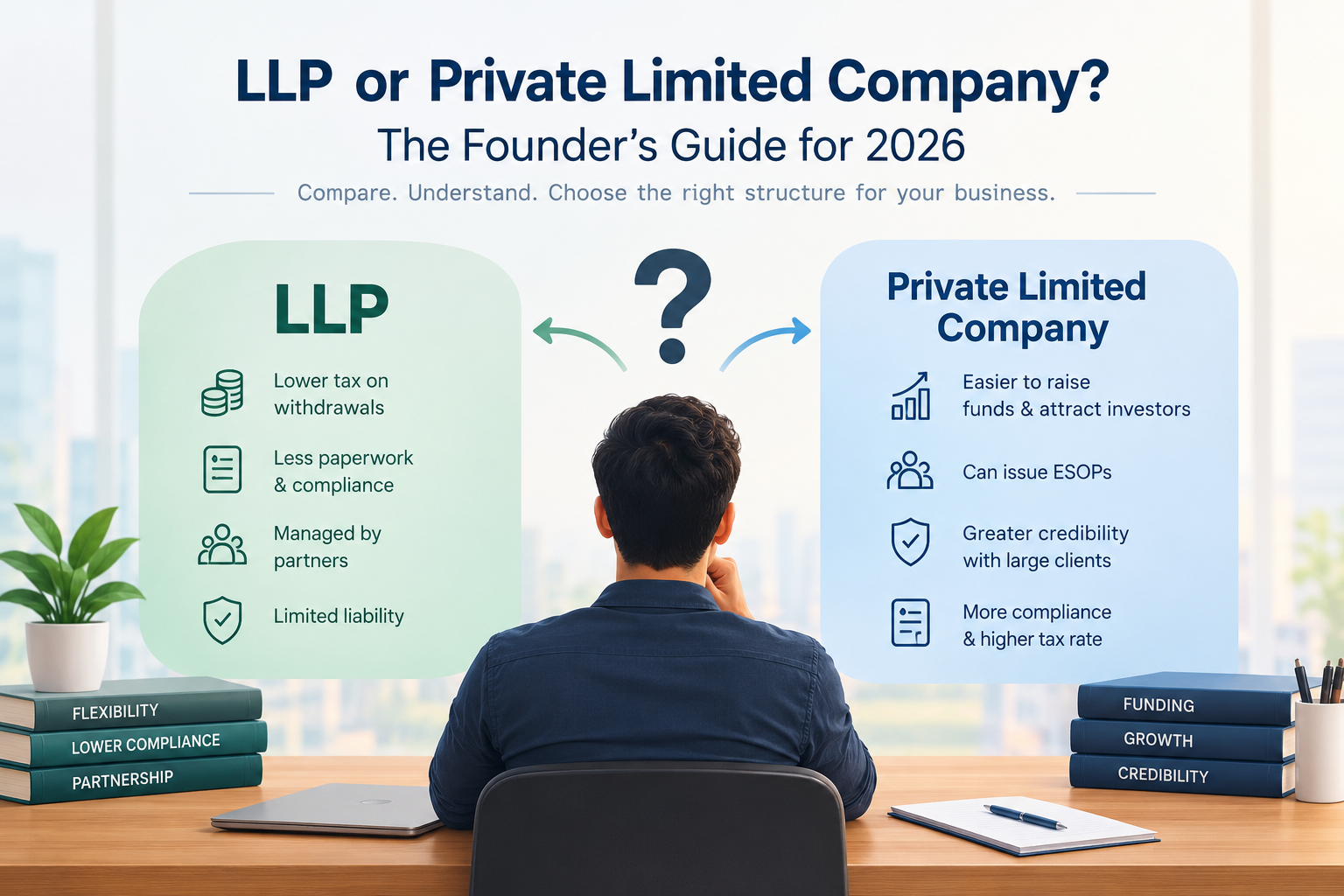
Three or more "yes" answers? A Private Limited Company is likely the better fit.
Mostly "no"? An LLP may give you lower tax on withdrawals and far less paperwork.
Read on to see why.
First, what exactly are you choosing between?
Private Limited Company. A company incorporated under the Companies Act, 2013. Ownership rests with shareholders, and management with the board of directors. The two may be the same people in a small company, but the law treats the roles separately. Ownership is represented by shares, which makes it easier to bring in investors or give equity to employees.Limited Liability Partnership. A body corporate registered under the Limited Liability Partnership Act, 2008. The partners own and run the business, and their rights are governed mainly by the LLP agreement. Each partner's liability is limited to the agreed contribution. A partner is not personally liable for the wrongful acts of another partner.
The side-by-side view
| Point | Private Limited Company | LLP |
|---|---|---|
| Governing law | Companies Act, 2013 | LLP Act, 2008 |
| Minimum and maximum | 2 to 200 shareholders; at least 2 directors | At least 2 partners, including 2 designated partners; no upper limit |
| Resident requirement | At least one director resident in India for 182 days or more in the financial year | At least one designated partner resident in India for 120 days or more in the financial year |
| Ownership | Shares, freely issued and transferred subject to the articles | Partnership interest, transferred as per the LLP agreement |
| Base income-tax rate | 22% under the concessional regime (25.17% effective), or 25%/30% under the normal regime | 30% (31.2% effective; 34.94% where income exceeds Rs 1 crore) |
| Tax on distribution | Dividends taxed again in shareholders’ hands | Share of profit exempt in partners’ hands |
| Statutory audit | Compulsory, whatever the size | Only if turnover exceeds Rs 40 lakh or contribution exceeds Rs 25 lakh |
| Annual ROC filings | AOC-4 (financial statements) and MGT-7 or MGT-7A (annual return) | Form 8 (statement of account and solvency) and Form 11 (annual return) |
| Equity funding and ESOPs | Possible | Not possible |
| Foreign investment | Permitted as per sectoral caps and routes | Permitted under the automatic route only in sectors with 100% automatic route and no FDI-linked conditions |
| Closure | Strike-off (Form STK-2) or winding up | Strike-off (Form 24) or winding up |
The question everyone asks: which one saves more tax?
Company. A domestic company can opt for the concessional regime at 22% (Section 115BAA of the 1961 Act, carried into the Income-tax Act, 2025). With the flat 10% surcharge and 4% cess, the effective rate is 25.17%. The company then gives up most profit-linked deductions and incentives, but is outside Minimum Alternate Tax (MAT). A company that stays in the normal regime pays 25% (where turnover in the base year is within Rs 400 crore) or 30%, plus surcharge and cess. It is also subject to MAT. The Finance Act, 2026 reduced MAT to 14% of book profit and made it a final tax from tax year 2026-27, with no fresh MAT credit.Profits paid out as dividend are taxed again in the shareholders' hands at their slab rates. For an individual in the highest bracket, this works out to as much as 35.88%, as surcharge on dividend income is capped at 15%.
LLP. An LLP pays tax at 30%, plus 12% surcharge where income exceeds Rs 1 crore, and 4% cess. The effective rate is 31.2%, or 34.94% above Rs 1 crore. The share of profit received by partners is exempt in their hands, so profits are taxed only once. Alternate Minimum Tax at 18.5% applies only if the LLP claims specified profit-linked deductions.
An LLP can also pay remuneration and interest to working partners, which is deductible within prescribed limits:
• Remuneration: on the first Rs 6 lakh of book profit (or in case of loss), Rs 3 lakh or 90% of book profit, whichever is higher; on the balance, 60% of book profit.
• Interest on capital: up to 12% simple interest a year, if authorised by the LLP agreement.
• TDS: from 1 April 2025, tax is deducted at 10% on remuneration, interest and similar payments to partners exceeding Rs 20,000 in a year.
These amounts are taxed in the partners' hands at their slab rates.
A simple illustration. Consider a business earning Rs 1 crore of taxable profit, before any salary or remuneration to the owners. The owners are in the highest tax bracket.
| Point | Private Limited Company (Concessional Regime) | LLP |
|---|---|---|
| Tax on the entity’s profit | Rs 25,16,800 (25.168%) | Rs 31,20,000 (31.2%) |
| Profit available after entity tax | Rs 74,83,200 | Rs 68,80,000 |
| Tax when distributed to owners | Rs 26,84,972 (35.88% on dividend) | Nil (exempt share of profit) |
| Amount in owners’ hands if fully distributed | Rs 47,98,228 | Rs 68,80,000 |
| Total tax if fully distributed | Rs 52,01,772 | Rs 31,20,000 |
The bottom line on tax
• Taking the profits home? The LLP leaves about Rs 21 lakh more in the owners' hands on every Rs 1 crore of profit.• Ploughing profits back into the business? The company wins, with 25.17% tax against 31.2% or more for an LLP.
Salary to directors and remuneration to partners change these numbers, so run the comparison on your own figures before deciding.
How much paperwork are you signing up for?
An LLP has a noticeably lighter compliance load. The main annual items are:| Requirement | Private Limited Company | LLP |
|---|---|---|
| Statutory audit | Every year, by a Chartered Accountant appointed in Form ADT-1 | Only where turnover exceeds Rs 40 lakh or contribution exceeds Rs 25 lakh |
| Meetings | At least four board meetings a year (two for a small company), and an annual general meeting | No mandatory meetings |
| Annual filings with the ROC | AOC-4 within 30 days of the AGM; MGT-7 or MGT-7A within 60 days of the AGM | Form 11 by 30 May; Form 8 by 30 October |
| Director or partner KYC | DIR-3 KYC once every three financial years, from 31 March 2026 | Same, for designated partners holding a DIN |
| Other returns | DPT-3, MSME-1 and other event-based forms where applicable | Event-based forms for change in partners or agreement |
| Tax audit | Where turnover exceeds Rs 1 crore (Rs 10 crore if cash transactions are within 5%) | Same |
Two recent changes have narrowed the gap for smaller companies. From 1 December 2025, a private
company with paid-up capital up to Rs 10 crore and turnover up to Rs 100 crore qualifies as a small
company. A small company needs only two board meetings a year and need not prepare a cash flow
statement. From 31 March 2026, directors file KYC once every three years instead of annually.
Planning to raise money? Read this first
This is where the company structure is clearly stronger.
• Equity investment. Angel investors and venture funds invest through equity shares or compulsorily convertible instruments. An LLP cannot issue shares, so institutional investors rarely invest in one.
• Angel tax removed. The tax on share premium under Section 56(2)(viib) was abolished from assessment year 2025-26. This has removed a long-standing difficulty in raising funds at a premium.
• ESOPs. A company can grant stock options to employees. An LLP cannot, which matters in businesses that compete for talent.
• Change in ownership. Shares can be transferred by executing a transfer instrument, subject to the articles. In an LLP, admitting or removing partners needs consent under the LLP agreement and filings with the ROC.
• Bank finance. Banks lend to both. A company’s audited, standardised financial statements often make credit appraisal easier.
• Equity investment. Angel investors and venture funds invest through equity shares or compulsorily convertible instruments. An LLP cannot issue shares, so institutional investors rarely invest in one.
• Angel tax removed. The tax on share premium under Section 56(2)(viib) was abolished from assessment year 2025-26. This has removed a long-standing difficulty in raising funds at a premium.
• ESOPs. A company can grant stock options to employees. An LLP cannot, which matters in businesses that compete for talent.
• Change in ownership. Shares can be transferred by executing a transfer instrument, subject to the articles. In an LLP, admitting or removing partners needs consent under the LLP agreement and filings with the ROC.
• Bank finance. Banks lend to both. A company’s audited, standardised financial statements often make credit appraisal easier.
Three things founders often miss
• Startup benefits. DPIIT startup recognition and the profit-linked deduction for eligible startups
(Section 80-IAC of the 1961 Act) are available to both companies and LLPs.
• Converting later. A company can convert into an LLP without capital gains tax if conditions are met: turnover not exceeding Rs 60 lakh and total assets not exceeding Rs 5 crore in each of the three preceding years, among others. Moving from an LLP to a company later involves its own procedure and tax analysis. It is better to choose correctly at the start.
• Professional practices. Some professions restrict the forms in which they can practise. Check the rules of the relevant professional body before choosing.
• Converting later. A company can convert into an LLP without capital gains tax if conditions are met: turnover not exceeding Rs 60 lakh and total assets not exceeding Rs 5 crore in each of the three preceding years, among others. Moving from an LLP to a company later involves its own procedure and tax analysis. It is better to choose correctly at the start.
• Professional practices. Some professions restrict the forms in which they can practise. Check the rules of the relevant professional body before choosing.
So, which one is right for you?
| An LLP Generally Suits | A Private Limited Company Generally Suits |
|---|---|
| Consulting, advisory and other service businesses run by a few partners | Startups that plan to raise angel, venture or private equity funding |
| Family businesses and closely held ventures without plans for outside investors | Businesses that want to offer ESOPs to attract employees |
| Owners who expect to withdraw most of the profits each year | Businesses that will retain and reinvest most of their profits |
| Small businesses that want to keep compliance cost low | Businesses dealing with large corporates or government bodies that prefer a company |
The choice should follow the business plan for the next three to five years, not just the cost of registration today.
Myth vs fact
| What Founders Often Hear | What the Law Actually Says |
|---|---|
| “An LLP always pays less tax.” | An LLP pays more tax on profit kept in the business. It saves tax only when profits are withdrawn. |
| “A company means endless compliance.” | Small companies (paid-up capital up to Rs 10 crore and turnover up to Rs 100 crore) need only two board meetings a year, and director KYC is now once in three years. |
| “An LLP never needs an audit.” | Audit is compulsory once turnover crosses Rs 40 lakh or contribution crosses Rs 25 lakh. |
| “We can switch to a company whenever investors come.” | Conversion is possible, but it takes time and tax planning. Investors often prefer to see a company from day one. |
| “Raising money at a premium attracts angel tax.” | Angel tax was abolished from assessment year 2025-26. |
Frequently asked questions
Is an LLP always cheaper in tax than a company?
No. An LLP pays more tax at the entity level (31.2% or
34.94%) than a company in the concessional regime (25.17%). The LLP is cheaper only when profits are
distributed, because dividends from a company are taxed again.
Can a single person form an LLP?
No. An LLP needs at least two partners. A single founder can consider
a One Person Company instead.
Do LLPs need an audit every year?
Only if turnover exceeds Rs 40 lakh or contribution exceeds Rs 25
lakh in the year. A tax audit may still be needed under the Income-tax Act, depending on turnover.
Can foreign investors invest in an LLP?
Yes, but only in sectors where 100% foreign investment is
allowed under the automatic route without FDI-linked conditions. A company has wider access.
Can we start as an LLP and convert to a company when we raise funds?
Yes, an LLP can convert into a
company under the Companies Act. The process takes time and needs tax planning. If funding is
expected within a year or two, it is usually simpler to start as a company.